 Lumi Kids
Spanish for Kids: How to Practice Beyond the Classroom Today
If your child is coming home from school saying "hola" and "gracias" but nothing more, you're not doing anything wrong — you're seeing exactly how much a typical school Spanish program produces on its own. In most U.S. elementary and middle schools that offer a world language before high school, that language is Spanish, but the class usually meets for a short period once or twice a week, which is enough to introduce the language but not enough, by itself, to make it stick. This guide covers what you can realistically do outside those class minutes: free vocabulary you can start today, what "near me" classes and tutors actually look like, a simple home routine, and where an app can reasonably fit in.
Why Is Spanish the Language Most American Kids Meet at School?
It's not a coincidence that "Spanish for kids" is searched far more often in the U.S. than "French for kids" or "Mandarin for kids." When a school district only offers one world language before high school, it is almost always Spanish — schools already have Spanish-speaking staff, established textbooks, and a large Spanish-speaking population in most communities, which makes it the practical default choice for a school building a language program.
That matters for what you do at home, because it means your child's Spanish class is probably not a specialized immersion program — it's a general-purpose introduction, often taught alongside several other subjects by a teacher who may be covering multiple grade levels. That's not a criticism of the teacher; it's just a description of what a "once or twice a week" program can realistically deliver, and it's the reason home reinforcement makes such a visible difference.
How Much Spanish Actually Sticks From One Class a Week?
A class that meets for a short period once or twice a week adds up to a small number of total hours across a school year — nowhere near enough, on its own, for a child to become conversational. That's true of any subject taught in short weekly doses; it's simply how language works when the total contact time is measured in minutes, not hours, each week.
This isn't a reason to expect more from the school program. It's the reason home practice has an outsized effect: a child getting even a little extra spoken practice between classes is getting a meaningfully larger share of their total Spanish exposure from home than from school, which is exactly why parents searching for "Spanish for kids" resources are onto something real, not just being anxious.
What's Different About Starting With a Toddler vs. a School-Age Kid?
"Spanish for toddlers" and "Spanish for kids" turn up in very similar searches, but a 2-year-old and a 7-year-old need almost opposite approaches.
A toddler can't yet follow instructions or sit through anything that resembles a lesson, so the only realistic goal is passive, repeated exposure: the same few songs, the same few labeled objects, in the same routines, over and over. There's no test to pass and no schedule to keep — a toddler who hears "gato" every time they see the cat, for months, is doing exactly the right amount of "practice," even though it looks like nothing is happening.
A school-age child, by contrast, can follow directions, ask questions, and notice when something is repeated too often to still be interesting. That's the child a weekly routine, a tutor, or a structured app actually starts to make sense for, because they can engage with the idea that this is a skill being built, not just background noise. If you're starting with a toddler now, the goal isn't to get ahead — it's to build a comfortable, unpressured baseline that a real routine can be layered onto once they're old enough for one.
| Toddlers (roughly 1-3) | School-age (roughly 5-9) | |
|---|---|---|
| Realistic goal | Passive familiarity, not production | Active vocabulary and short spoken answers |
| Best format | Songs, labeled objects, repetition in routines | Structured routine, class, tutor, or app |
| Session shape | No fixed session — woven into the day | A short, dedicated block most days |
| How you'll know it's working | They recognize the word before they say it | They answer a simple question unprompted |
Free Ways to Start Practicing Spanish With Your Child Today
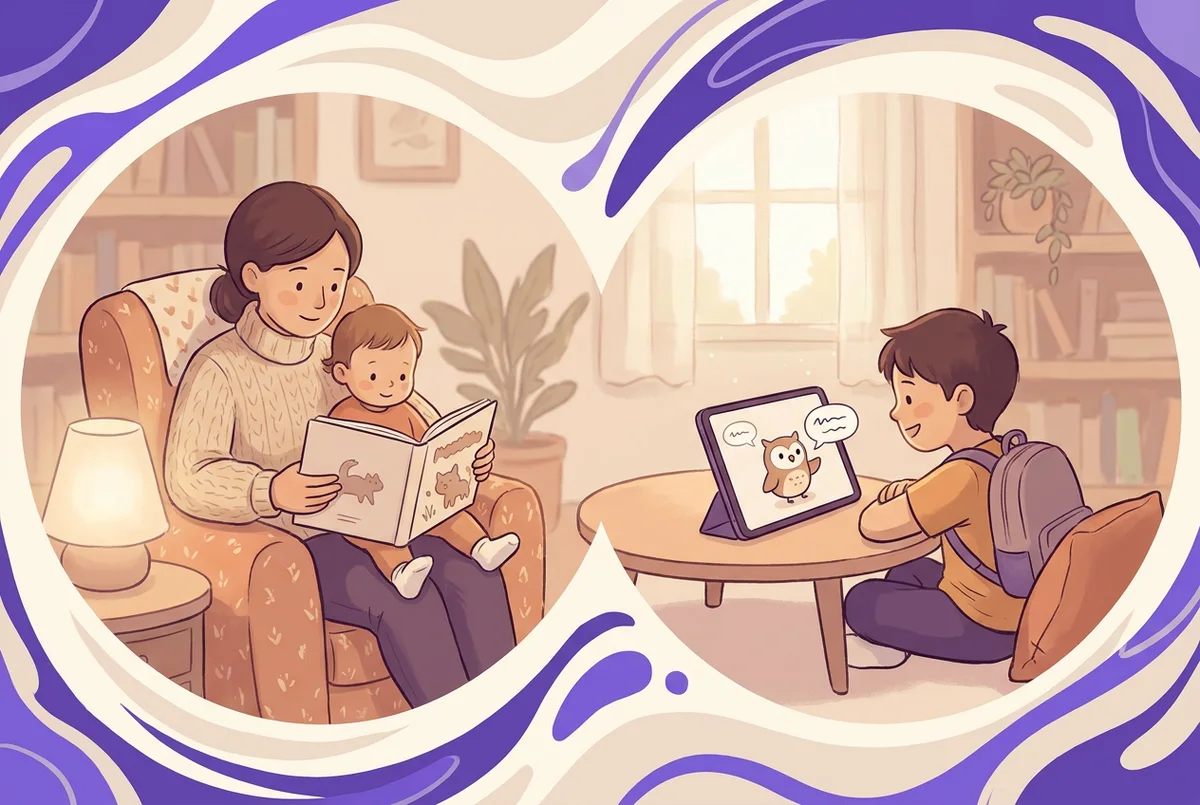
You don't need to buy anything to start. The most useful free practice comes from folding a handful of words into things your child already does every day, rather than sitting down for a formal "Spanish lesson."
| Category | A few starter words | Where to use them at home |
|---|---|---|
| Colors | rojo, azul, amarillo, verde | While getting dressed, drawing, or sorting toys |
| Numbers 1-10 | uno, dos, tres... diez | Counting stairs, snacks, or toys during cleanup |
| Days of the week | lunes, martes, miércoles | Naming the day each morning at breakfast |
| Family words | mamá, papá, abuela, abuelo | Pointing to family photos or during video calls with relatives |
The point isn't to memorize the list — it's repetition inside a real moment. A child who hears "¿de qué color es?" while getting dressed every morning for two weeks will retain that phrase better than one who saw it once on a worksheet.
Local Classes, Tutors, and "Near Me" Options: What to Expect
Searches like "Spanish classes for kids near me" or "Spanish tutor for kids" usually mean a parent is ready for something more structured than what they can do alone at home. Here's roughly what each option tends to offer.
| Format | Typical group size | Speaking time per child | Best fit |
|---|---|---|---|
| Community or library class | Small group | Limited — shared among the group | Kids who like structure and peers |
| After-school Spanish club | Group, school-based | Limited, varies by teacher | Families who want it built into the school day |
| Private tutor (in-person or online) | One-on-one | High — full session is theirs | Kids who need more individual correction |
| Homeschool co-op class | Small group, mixed ages | Moderate | Homeschooling families wanting social practice too |
Before you search "near me," it helps to know which of these four you actually want, since the search results will mix all of them together. A group class and a private tutor solve different problems even though both show up under the same search. Cost and availability both vary a lot by city and by provider, so it's worth calling or emailing two or three options and asking the same two questions of each: how much of the session is your child actually speaking, and what happens if the schedule doesn't work out one week. The answers tell you more than any price list.
Homeschool Spanish: A Simple Weekly Routine
You don't have to be homeschooling in the formal sense to use a homeschool-style weekly routine — it just means treating Spanish as a short, regular block rather than something that only happens at school.
| Day | Focus | How |
|---|---|---|
| Monday | New words | Introduce 3-5 words tied to something happening that week |
| Tuesday | Listen and point | Say a word, child points to or finds the matching object |
| Wednesday | Around the house | Hunt for the week's words at home: "¿Dónde está la silla?" |
| Thursday | Mini conversation | Ask 3-4 simple questions; one-word answers are a win |
| Friday | Song or short video | 10 minutes, then recall 2-3 words together afterward |
| Weekend | Mixed review | Ask the week's words out of order; anything missed carries over |
Two rules make this routine last: keep each day under 10-15 minutes, and don't correct every mistake on the spot — repeat the word correctly once yourself and move on. Correcting constantly is one of the fastest ways to make a child stop wanting to try.
Worksheets, Books, and Screen-Free Practice
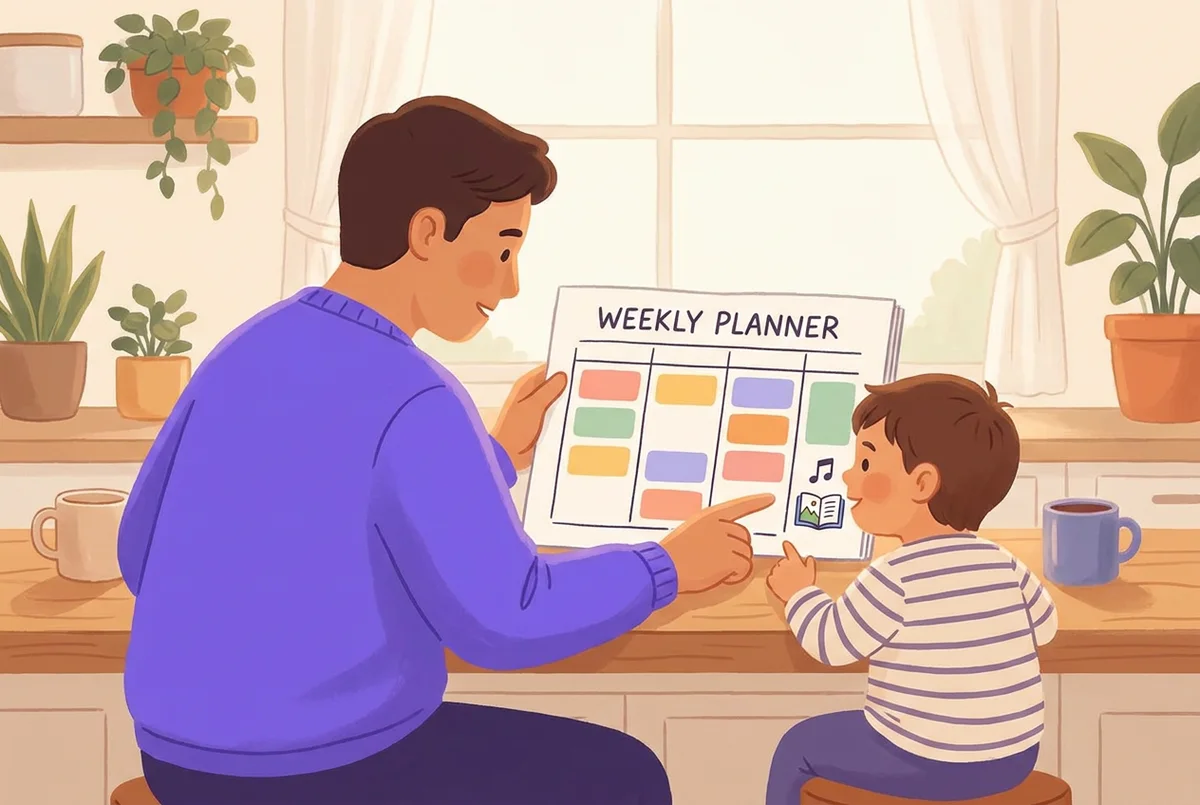
Printable worksheets and picture books remain some of the most searched Spanish resources for kids, and for good reason — they don't require a screen, and a library card makes most of them free.
Worksheets work best for children who are already reading and want to see the words written down, tracing or matching them to pictures. For a pre-reader, a picture book you read aloud (even haltingly, even if you're translating some of it yourself) does more, because the child is hearing the language in a real sentence rather than as an isolated word on a page. Bilingual picture books, where Spanish and English appear side by side, are a practical middle ground: your child hears the Spanish, and you both have the English right there if either of you gets stuck.
Games and Songs That Actually Teach Spanish
Not all "fun" practice teaches equally. The difference usually comes down to whether your child is producing the language or only hearing it.
- Songs your child sings along to count as real practice, because singing is a form of speaking. A repetitive children's song in Spanish, played on loop for a week, is genuinely one of the most effective low-effort tools available.
- Matching and memory games (picture-to-word, or picture-to-picture with you saying the word aloud) build recognition quickly and work well for younger kids who aren't ready for open conversation yet.
- Cartoons and videos are the most passive of the three. They're not wasted time, but watching silently doesn't build the same skill as singing or answering — treat video as a supplement, not the main event.
When (and How) an App Fits Into the Routine
An app isn't a replacement for the class, the tutor, or the bedtime picture book — it's most useful as the piece that provides frequent, low-pressure speaking practice on the days none of those are happening.
This is where Lumi Kids fits in. It's a language app for children ages 4-9 where Lumi, a purple owl, explains everything in the family's own language, and Spanish is one of 11 target languages a child can work through across a journey of 72 islands and four levels, each ending in a test and a certificate. The centerpiece is live conversation: your child can talk out loud with Lumi in Spanish, get gently corrected without being made to feel wrong, and earn stars for words said correctly — which is exactly the kind of low-stakes speaking practice that's hardest to arrange for free on a regular schedule. There's no subscription (one-time talk-minute packs unlock levels and add conversation time), no ads, no account, and a parent-only area with a daily time limit and a weekly report of practice time and words worked on. A parent has to turn live conversation on, and the first minute is free.
Whatever tool you choose, the same rule from the homeschool routine above still applies: short and frequent beats long and rare, and a few minutes of your child actually saying the word out loud is worth more than a long stretch of listening.
The Bottom Line
A once- or twice-a-week Spanish class at school is a starting point, not a finish line, and that's true no matter how good the teacher is — it's simply a function of how little total time the class has. Between free vocabulary woven into daily routines, a local class or tutor if your family wants more structure, a simple homeschool-style weekly plan, and a few minutes of real speaking practice wherever you can find it, most of the gap between "took a Spanish class" and "can actually use some Spanish" gets closed at home, in small pieces, not in one big effort.
You might also like: Best Language Learning Apps for Kids in 2026: Parent's Guide
Frequently asked questions
Why do so many U.S. schools teach Spanish specifically, not another language?
When an American elementary or middle school offers only one world language before high school, it is very often Spanish. It's the language most schools already have staff, textbooks, and community demand for, which is why so many families' first experience with a foreign language at school is Spanish rather than French, German, or Mandarin.
Is it too late to start Spanish if my child is already 7 or 8?
No. Younger children have an easier time with pronunciation and lose self-consciousness faster, but a 7 or 8 year old can still make fast progress — often faster than a toddler, because they can follow instructions, ask questions, and read along once basic reading is in place.
How many minutes a day should my child practice Spanish at home?
Somewhere around 10 minutes of focused, spoken practice most days will do more than a single long session once a week. The goal isn't to replicate a classroom at home; it's to keep the language present often enough that the weekly class isn't the only contact your child has with it.
Are free Spanish resources for kids actually enough, or do we need to pay for something?
Free resources — songs, picture books from the library, basic vocabulary practice at home — are genuinely enough to build a foundation, especially for a child who is just starting out. Paid options (tutors, classes, apps with live practice) tend to matter more once a child has the basics and needs a reliable way to actually speak and be corrected, since that's harder to arrange for free on a regular schedule.
Should I look for a tutor or a class for my child?
A class usually gives more structure and peer interaction but less individual speaking time per child. A private tutor gives more one-on-one speaking practice but at a higher cost per hour and without the group energy some kids need to stay motivated. Neither is right for every family — it depends on whether your child does better with peers watching or one-on-one attention.
My child understands Spanish but won't speak it. What's going on?
This is extremely common and isn't a sign that nothing is working. Understanding (receptive language) almost always develops before speaking (productive language), especially in children who hear more Spanish than they're asked to produce. The fix isn't more listening — it's more low-pressure opportunities to answer out loud, even with one-word answers.
Do songs and cartoons in Spanish actually help, or is that just screen time?
They help most as a supplement, not a replacement for active practice. A song your child sings along to is a form of production, not just listening, which is genuinely useful. A cartoon they watch silently is closer to passive exposure — pleasant and not wasted, but it won't do the same job as being asked a direct question and answering it.
How do I know if my child is actually making progress?
Look for small, concrete signs rather than fluency: naming an object without being prompted, answering a simple question with more than one word, correcting themselves when they mix up a word, or using a phrase from home in an unrelated context. Vocabulary lists memorized for a quiz are the least reliable sign, since they're often forgotten right after.