Lumi Kids
Spanish
The most taught language in US schools. Latin American Spanish, with a say-it guide for every word.
Which language should your child learn? Here are the ten languages of Lumi Kids for English-speaking families, each with its 64 first words in Lumi's voice, the sounds that are new for an English speaker and simple ways to practice at home.
There is no single best language for every child. The language that lasts is the one your child hears and uses: at home, at school, with friends or on visits to family. In the US that is often Spanish, because it is the most taught language in schools and the most spoken language after English. In England, French is the most widely taught language in primary schools. For heritage families, a grandparent's language comes with built-in conversation partners.
Four questions settle it for most families: Who around us speaks it? What does our school teach, or will teach next? Is there a family connection? And which language makes our child curious? A five-year-old who loves Japanese picture books will practice more than one who was assigned a language for its job prospects.
| Language | Where your child may use it | New for an English speaker |
|---|---|---|
| Spanish | US schools and neighborhoods, travel in the Americas and Spain | rolled r, the breathy j; reads the way it is written |
| French | UK primary schools, Canada, travel | nasal vowels, the French r, silent final letters |
| Mandarin Chinese | family, Chinese school, travel | four tones; characters (Lumi shows traditional ones and pinyin) |
| German | US schools, family, travel | ü, ö, ch; der, die, das |
| Japanese | stories, family, travel | two kana scripts; long and short vowels |
| Italian | family, travel | double consonants; clear vowels |
| Arabic | family, community, weekend school | right-to-left script; sounds made deep in the throat |
| Portuguese (Brazil) | family, travel | nasal vowels; r at the start sounds like h |
| Korean | family, Korean school, stories and music | Hangul letters; three kinds of k, p, t |
| Turkish | family, travel | six extra letters (ç, ğ, ı, ö, ş, ü); words grow with endings |
Can a young child learn two languages at once? Yes, many do, especially in bilingual families; it simply takes time with each. Our guides on the best age to start and raising a bilingual child cover the research and what to expect.
The most taught language in US schools. Latin American Spanish, with a say-it guide for every word.
The language most English primary schools teach. Nasal vowels and silent letters, explained simply.
Taiwan Mandarin with traditional characters and pinyin. The four tones, by ear.
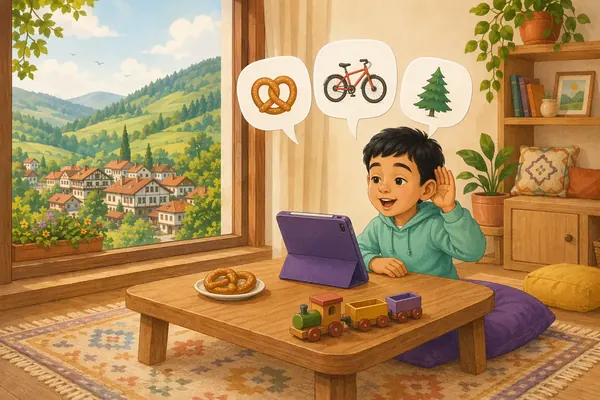
Clear sounds once you know ü, ö and ch. Every noun comes with der, die or das.

Words in hiragana and katakana with their romaji; five vowels like Spanish.
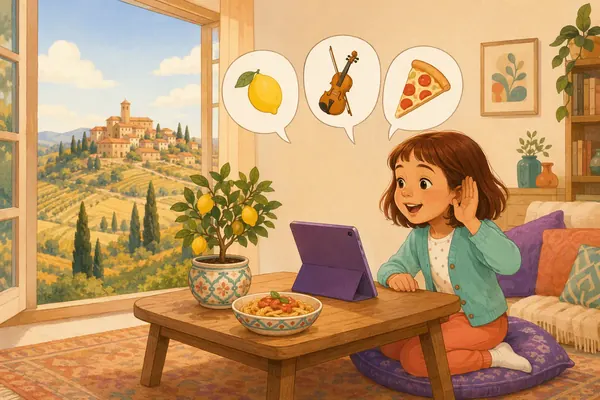
A favorite for Italian-American families: double consonants and very clear vowels.
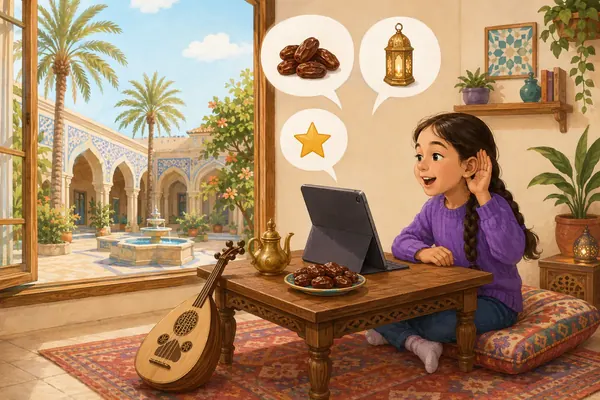
Modern Standard Arabic, right to left, with a Latin-letter guide for every word.
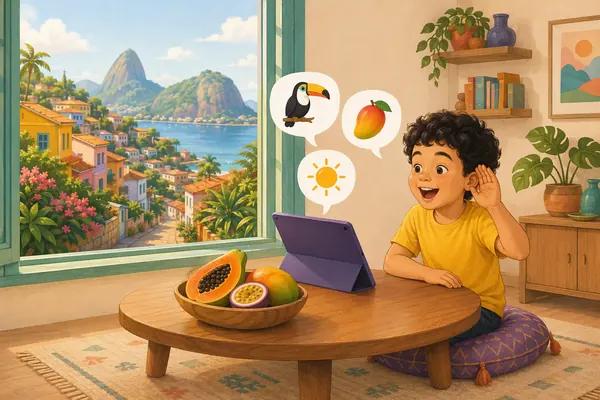
Brazilian Portuguese: nasal vowels and a soft, musical sound.

Hangul is an alphabet: 64 first words with their romanization.
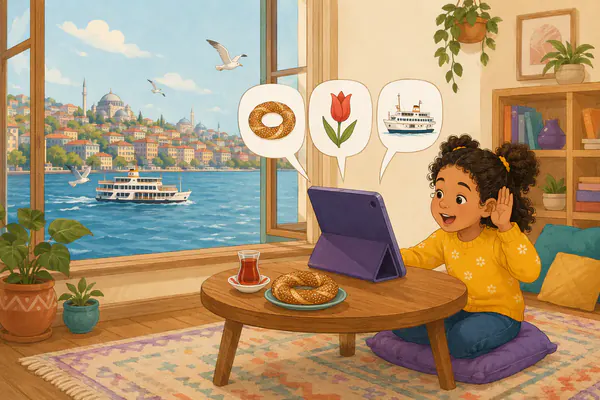
Read the way it is written, with six letters English doesn't have.
Facts on this page come from these pages (checked October 5, 2026) and from the app itself.
The one your child will hear and use. For most US families that is Spanish; for many families in England it is French, the most widely taught language in primary schools. Heritage families often do best with the family's language, because grandparents and relatives give real reasons to speak it.
Young children learn the sounds of any language by listening and copying; reading a new script can come later. Tones and new sounds take practice, so short daily listening and speaking matter more than which language you pick.
Yes, but each language needs regular time. If your child already uses two languages at home, adding a third at school is common. If you are starting from English only, one new language at a time is easier to keep up.
An English-speaking family can choose from ten: Spanish, French, Mandarin Chinese (traditional characters), German, Japanese, Italian, Arabic, Portuguese (Brazil), Korean and Turkish. Lumi explains in English; the language can be changed later, and progress is kept for each language.
Yes. The 64 first words of every language, with Lumi's audio, are free on these pages; the first two levels of the app are free too. Printable word lists and worksheets are on the printables page.
Lumi Kids for iPhone and iPad: ten languages for English-speaking families, ages 4–9. The first two levels are free.