Lumi Kids
Food in Spanish for Kids: Snack and Breakfast Words
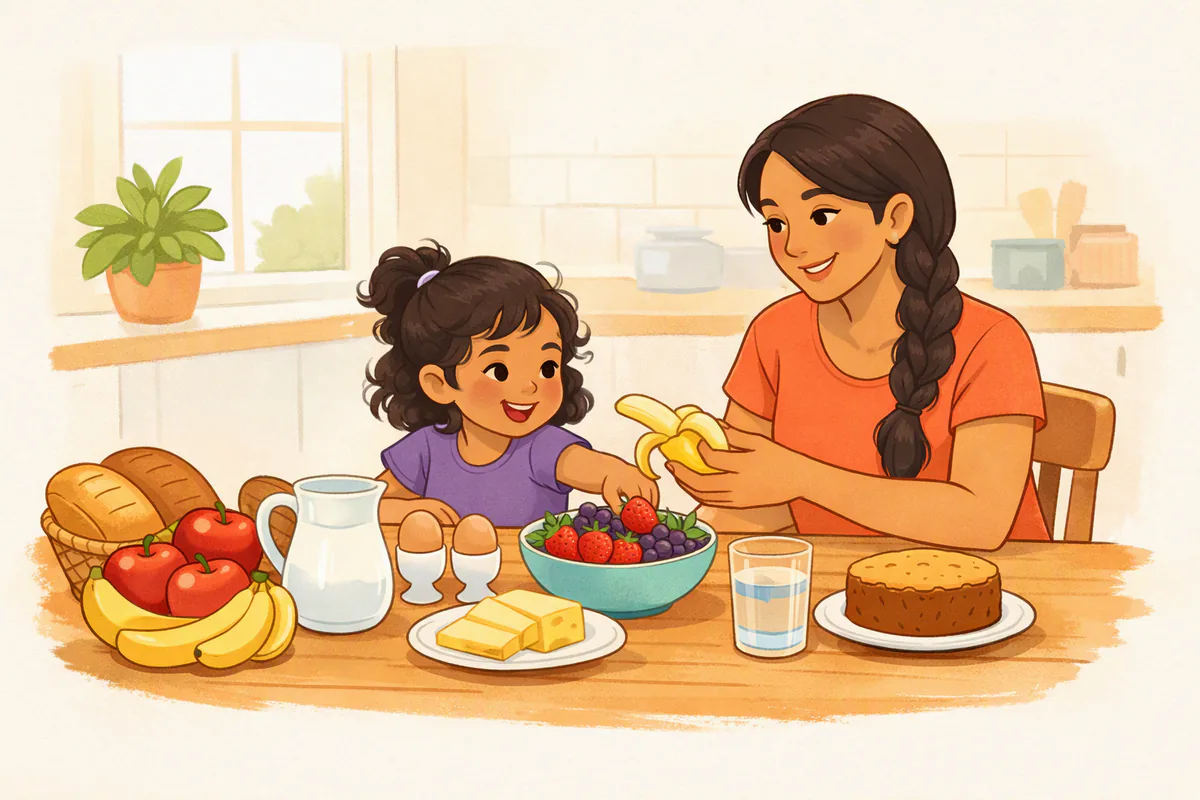
Kids eat several times a day, which makes food the easiest Spanish to practice: every snack is a short lesson that nobody has to plan. Here are 12 everyday food words with English meanings, a "say it" guide and Lumi's audio, the phrases for asking and thanking, and a snack-time routine that takes two minutes.
Food words in Spanish, with audio
| Spanish | English | Say it | Listen |
|---|---|---|---|
| manzana | apple | mahn-SAH-nah | |
| plátano | banana | PLAH-tah-noh | |
| pan | bread | PAHN | |
| leche | milk | LEH-cheh | |
| huevo | egg | WEH-boh | |
| queso | cheese | KEH-soh | |
| agua | water | AH-gwah | |
| pastel | cake | pahs-TEHL | |
| fresa | strawberry | FREH-sah | |
| uvas | grapes | OO-bahs | |
| jugo | juice | HOO-goh | |
| galleta | cookie | gah-YEH-tah |
Latin American words: plátano, pastel and jugo. In Spain you will also hear tarta for cake and zumo for juice. Voices: Lumi (AI-generated voice).
Three sounds to notice: qu in queso sounds like k, h at the start of huevo is silent (WEH-boh), and ll in galleta sounds like y.
Same food, different word
Spanish is the official language of about 20 countries, and food words are one place where they often differ. Lumi speaks Latin American Spanish; here is what your child might also hear:
| Lumi says | Also heard | English |
|---|---|---|
| plátano | banana (Argentina, Uruguay), guineo (Caribbean) | banana |
| pastel | torta (much of South America), tarta (Spain) | cake |
| jugo | zumo (Spain) | juice |
| fresa | frutilla (Argentina, Chile) | strawberry |
If your family, your child's school or a babysitter uses a different word, use theirs. Knowing two words for one thing is a real advantage, not a mix-up.
Phrases for snack time
- Tengo hambre. (TEHN-goh AHM-breh): "I'm hungry."
- ¿Quieres una manzana? (KYEH-rehs OO-nah mahn-SAH-nah): "Do you want an apple?"
- Sí, por favor. / No, gracias. "Yes, please." / "No, thank you."
- Quiero agua, por favor. (KYEH-roh AH-gwah por fah-BOR): "I want water, please."
- ¡Qué rico! (keh REE-koh): "Yummy!"
A two-minute snack routine
- Put two choices on the table: ¿Manzana o plátano?
- Your child chooses in Spanish. A single word counts.
- Add por favor before you hand it over, and gracias after.
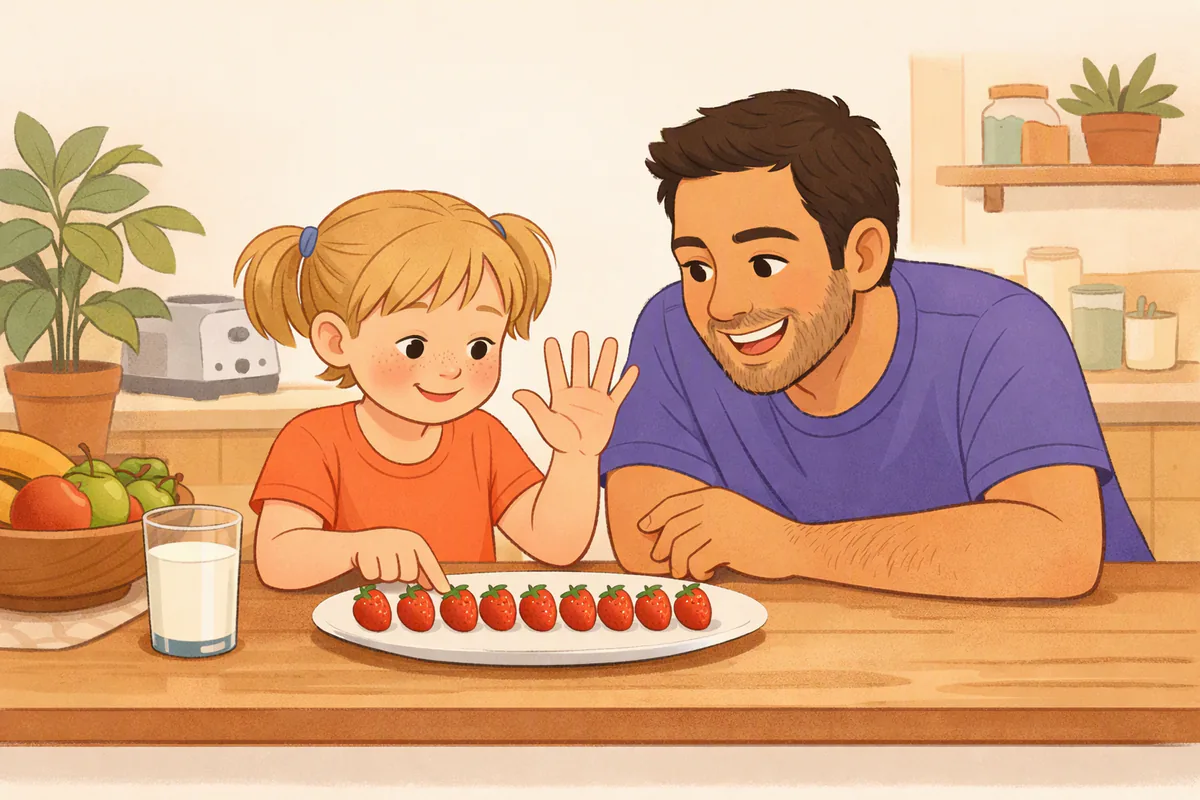
- While your child eats, count the pieces together in Spanish or name the colors: la fresa roja, el plátano amarillo.
Two minutes, every day, and your child has used six to ten Spanish words without a worksheet. For a full daily plan, see our guide to teaching your child Spanish at home.
In the Lumi Kids app, food is the sixth world of the free Seed level: manzana, plátano, pan, leche, huevo, queso, agua and pastel, with sentences like Quiero agua, por favor. Your child listens, plays a memory game with the words and then talks about food with Lumi, the AI owl, out loud. See the app.
Free food in Spanish worksheet (PDF)
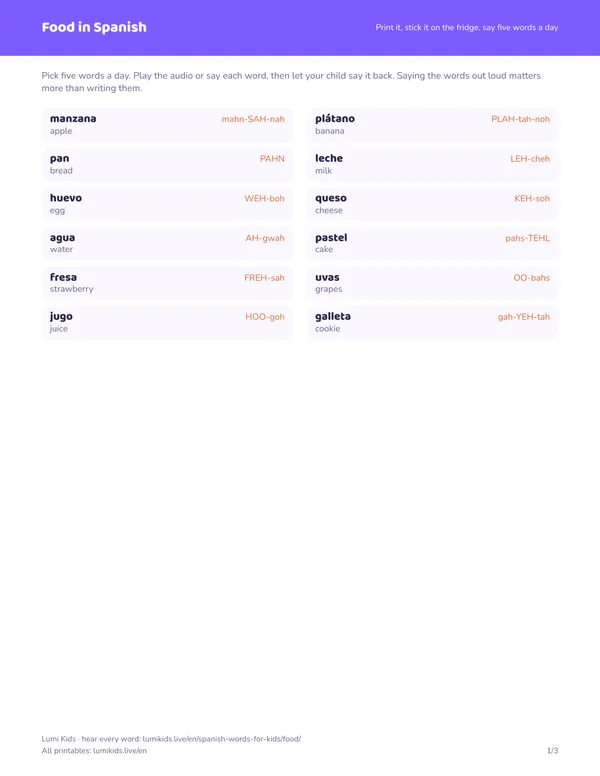
Three pages: the food words with a say-it guide, a matching worksheet (Spanish to English) and a writing sheet. Free to print at home or in class.
Download the PDF: Food in SpanishMore Spanish words for kids
- Colors in Spanish: every fruit has one.
- Numbers in Spanish: count the grapes.
- Spanish greetings and polite words: por favor and gracias.
- All Spanish words for kids.
Frequently asked questions
How do you say food words in Spanish?
Apple is manzana (mahn-SAH-nah), banana plátano (PLAH-tah-noh), bread pan, milk leche (LEH-cheh), egg huevo (WEH-boh), cheese queso (KEH-soh), water agua (AH-gwah) and cake pastel (pahs-TEHL). The table on this page has 12 food words with audio.
Is banana plátano or banana in Spanish?
It depends on the country. In Mexico and Spain a banana is usually a plátano; in Argentina and Uruguay it is a banana; in some countries plátano also means plantain. Lumi uses plátano.
How do kids say I'm hungry in Spanish?
Tengo hambre (TEHN-goh AHM-breh), literally "I have hunger". Thirsty is Tengo sed (TEHN-goh SEHD).
Why is it el agua if agua is a feminine word?
Feminine words that start with a stressed a-sound take el in the singular to keep the sound smooth: el agua fría. In the plural it is las aguas. Kids just learn el agua as one chunk.
How do you say yummy in Spanish?
¡Qué rico! (keh REE-koh) or ¡Está rico! Lumi says El queso es rico, "Cheese is yummy".
In the Lumi Kids app, Lumi the AI owl talks with your child, corrects gently and hands out stars. Ages 4–9, no ads. The first two levels and the first minute of live conversation are free.
Download on the App Store
The team behind Lumi Kids. Articles are written using published research on early-childhood language acquisition and the curriculum built into the app, and are reviewed and updated over time. Questions or corrections: hello@lumikids.live