Lumi Kids
German for kids
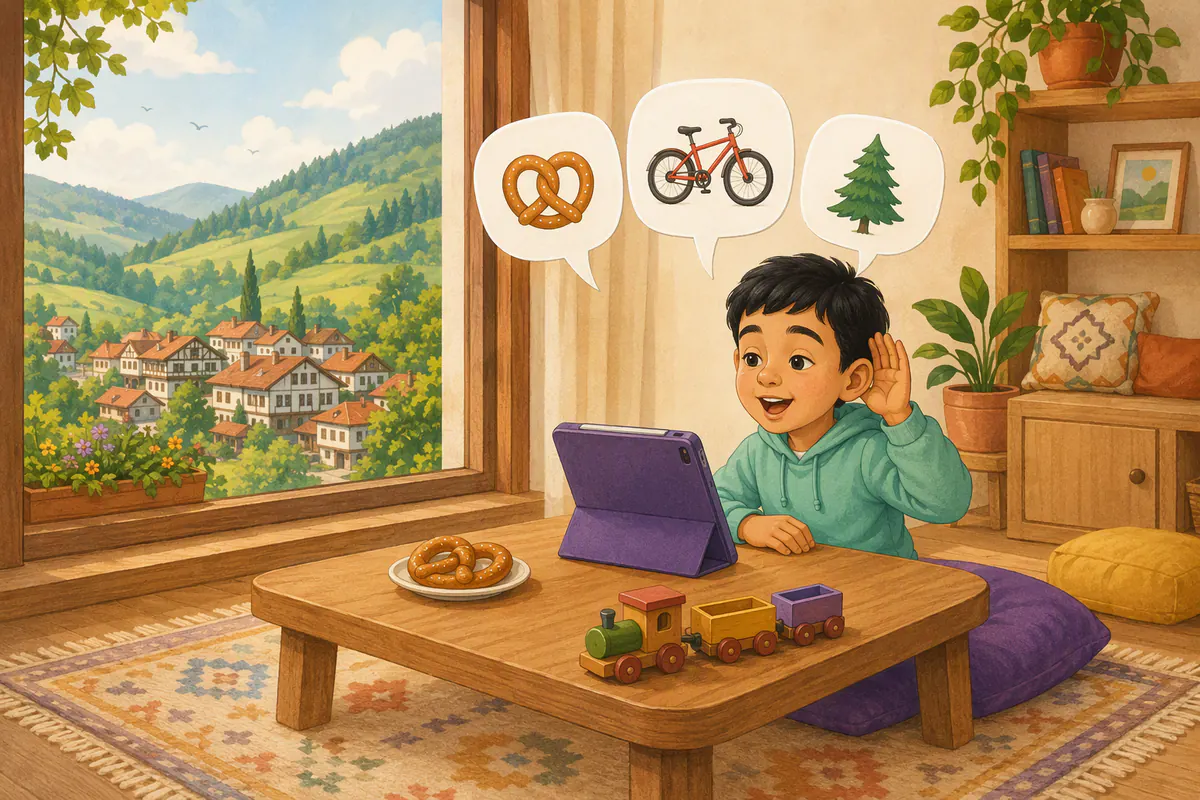
German is closer to English than most families expect: Ball, Baby, Fisch and Haus are among the first words. Here are the 64 first words of Lumi Kids with Lumi's voice, the article each noun takes and a say-it guide for English speakers.
Guides
- Best Age to Learn a Second Language: A Guide for Parentswhat research says about starting age
- How to Raise a Bilingual Child: Methods That Fit Real Familiesfor families who speak German at home
- Best Language Learning Apps for Kids in 2026: Parent's Guidehow to choose an app for a 4- to 9-year-old
Why German?
German is taught in 4% of US public schools (NCES, January 2024), mostly in middle and high school, so families who want it earlier usually start at home. Many choose it for family reasons, a move or a parent's work, or because it is spoken in Germany, Austria and much of Switzerland.
English and German are close relatives, which helps: der Ball, das Baby, der Fisch and das Haus need almost no explanation. German is also read the way it is written once a child knows a few letter combinations.
The new part is grammar: every noun is der, die or das. Children learn it best the way German children do, by hearing the article and the noun together, so the cards always show both.
The 64 first German words
These are the 64 words of the Seed level, eight worlds of eight words, each with a short sentence. Tap a card and Lumi says the word; the orange line is a say-it guide in English spelling, with the stressed syllable in capitals. The guide gets you close; Lumi's voice is the real thing. Nouns appear with their article, and German writes every noun with a capital letter.
Tap a card and Lumi says the word; ▶ next to a sentence reads it, and “Play all in order” plays a whole group. Voices: Lumi (AI-generated voice).
8 words · 8 sentences
Hello World · Hallo Welt
| Sentence | English | listen |
|---|---|---|
| Hallo, ich bin Lumi! | Hello, I am Lumi! | |
| Tschüss, bis bald! | Goodbye, see you! | |
| Ja, ich mag es! | Yes, I like it! | |
| Nein, danke. | No, thank you. | |
| Vielen Dank! | Thank you very much! | |
| Bitte hilf mir. | Please help me. | |
| Du bist mein Freund. | You are my friend. | |
| Guten Morgen, Lumi! | Good morning, Lumi! |
8 words · 8 sentences
Colors · Farben
| Sentence | English | listen |
|---|---|---|
| Der Apfel ist rot. | The apple is red. | |
| Der Himmel ist blau. | The sky is blue. | |
| Die Sonne ist gelb. | The sun is yellow. | |
| Der Frosch ist grün. | The frog is green. | |
| Ich mag Orange. | I like orange. | |
| Die Trauben sind lila. | The grapes are purple. | |
| Das Schwein ist rosa. | The pig is pink. | |
| Die Wolke ist weiß. | The cloud is white. |
8 words · 8 sentences
Numbers · Zahlen
| Sentence | English | listen |
|---|---|---|
| Ich habe einen Apfel. | I have one apple. | |
| Ich sehe zwei Enten. | I see two ducks. | |
| Drei Luftballons! | Three balloons! | |
| Vier Muffins. | Four cupcakes. | |
| Fünf Sterne! | Five stars! | |
| Sechs Erdbeeren. | Six strawberries. | |
| Sieben Fische. | Seven fish. | |
| Acht Blumen. | Eight flowers. |
8 words · 8 sentences
Animals · Tiere
| Sentence | English | listen |
|---|---|---|
| Die Katze macht miau. | The cat says meow. | |
| Der Hund ist glücklich. | The dog is happy. | |
| Der Vogel kann fliegen. | The bird can fly. | |
| Der Fisch kann schwimmen. | The fish can swim. | |
| Das Pferd ist groß. | The horse is big. | |
| Die Kuh macht muh. | The cow says moo. | |
| Der Löwe ist stark. | The lion is strong. | |
| Der Hase hüpft. | The rabbit jumps. |
8 words · 8 sentences
My Family · Meine Familie
| Sentence | English | listen |
|---|---|---|
| Ich liebe meine Mama. | I love my mom. | |
| Mein Papa ist groß. | My dad is tall. | |
| Meine Schwester ist nett. | My sister is kind. | |
| Mein Bruder spielt. | My brother plays. | |
| Oma backt Kekse. | Grandma bakes cookies. | |
| Opa erzählt Geschichten. | Grandpa tells stories. | |
| Das Baby ist klein. | The baby is small. | |
| Das ist meine Familie. | This is my family. |
8 words · 8 sentences
Food · Essen
| Sentence | English | listen |
|---|---|---|
| Ich esse einen Apfel. | I eat an apple. | |
| Die Banane ist gelb. | The banana is yellow. | |
| Ich mag Brot. | I like bread. | |
| Ich trinke Milch. | I drink milk. | |
| Ein Ei zum Frühstück. | An egg for breakfast. | |
| Käse ist lecker. | Cheese is yummy. | |
| Ich möchte Wasser, bitte. | I want water, please. | |
| Geburtstagskuchen! | Happy birthday cake! |
8 words · 8 sentences
My Body · Mein Körper
| Sentence | English | listen |
|---|---|---|
| Berühre deinen Kopf. | Touch your head. | |
| Ich habe zwei Augen. | I have two eyes. | |
| Das ist meine Nase. | This is my nose. | |
| Öffne deinen Mund. | Open your mouth. | |
| Ich höre mit meinen Ohren. | I hear with my ears. | |
| Klatsch in die Hände! | Clap your hands! | |
| Stampf mit den Füßen! | Stomp your feet! | |
| Meine Haare sind lockig. | My hair is curly. |
8 words · 8 sentences
Toys & Home · Spielzeug & Zuhause
| Sentence | English | listen |
|---|---|---|
| Ich kicke den Ball. | I kick the ball. | |
| Das Auto ist schnell. | The car is fast. | |
| Ich spiele mit meiner Puppe. | I play with my doll. | |
| Ich lese ein Buch. | I read a book. | |
| Ich umarme meinen Teddybär. | I hug my teddy bear. | |
| Ich schlafe in meinem Bett. | I sleep in my bed. | |
| Setz dich auf den Stuhl. | Sit on the chair. | |
| Das ist mein Haus. | This is my house. |
New sounds
| Sound or letter | What to know |
|---|---|
| ü | Say "ee" with your lips rounded as for "oo": grün (GREWN), fünf (FEWNF). |
| ö | Say "eh" with rounded lips: der Löwe (LUH-veh). |
| ch | After a, o and u it comes from the back of the throat (acht, Buch); after i and e it is a soft hiss, close to "sh" (Milch). |
| w and v | W sounds like English v (das Wasser, VAHS-ser); v usually sounds like f (der Vogel, FOH-gel). |
| z | Like "ts": die Katze (KAHT-seh), zwei (TSVY). |
| ei and ie | ei rhymes with "eye" (drei, weiß); ie sounds like "ee" (vier). |
| der, die, das | The three words for "the". Learn each noun with its article, like a first name and a last name. |
Practice at home
- Article and noun together. Say der Ball, not just Ball. Color-coding helps: blue sticky notes for der, red for die, green for das.
- Count everything. Eins, zwei, drei on the stairs; German numbers are easy to hear.
- Morning and evening. Guten Morgen at breakfast, gute Nacht at bedtime.
- Look for the cousins. Let your child find German words that sound like English ones: Hand, Haus, Fisch, Apfel.
How Lumi teaches it
In Lumi Kids your child starts at Seed, the first of four levels (Seed, Sprout, Sapling and Tree, 72 worlds in all). The 64 words on this page are Seed's eight worlds. Every world has at least six exercises: learn the words, listen and tap, card match, true or false, listen in order and talk with Lumi; higher levels add sentence building, stories and role play. Lumi explains in English and says the new words in standard German.
From age 7 the app adds reading and spelling in German, including the capital letters of nouns.
Seed and Sprout are free, with 60 seconds of live talk to try. Lumi Plus unlocks Sapling and Tree and adds 10 minutes of live talk a week: $14.99 a month or $119.99 a year, and the yearly plan starts with a 7-day free trial for new subscribers (App Store US, checked October 5, 2026). Before live talk is turned on, the app tells you, the parent, that Lumi is an AI. Lumi Kids does not record or store your child's voice. More about the app.
Sources
Facts on this page come from these pages (checked October 5, 2026) and from the app itself.
- ACTFL (March 2026): The State of K-12 World Language Education, data from the NCES School Pulse Panel, January 2024 (October 5, 2026)
- Pew Research Center (August 3, 2026): What do Americans think about language learning in US schools? (October 5, 2026)
- App Store (US): Lumi Kids: Learn Languages (October 5, 2026)
Frequently asked questions
Is German hard for English-speaking kids?
Many first words are easy because English and German are related. The new parts are a few sounds (ü, ö, ch) and der, die and das. Young children learn the articles by ear when they always hear them with the noun.
Why does German have three words for "the"?
German nouns are masculine (der), feminine (die) or neuter (das), and the article shows which. There is no simple rule for young learners, so the easiest way is to learn each noun with its article from the start.
Is Lumi's German from Germany, Austria or Switzerland?
Lumi speaks standard German from Germany. Austrians and Swiss understand it easily; their accents and some everyday words differ.
German with Lumi, a few minutes a day
Your child hears every word with its article, plays with it and then speaks with Lumi. The first two levels are free.