Lumi Kids
Colors in Spanish for Kids: Pronunciation and Audio
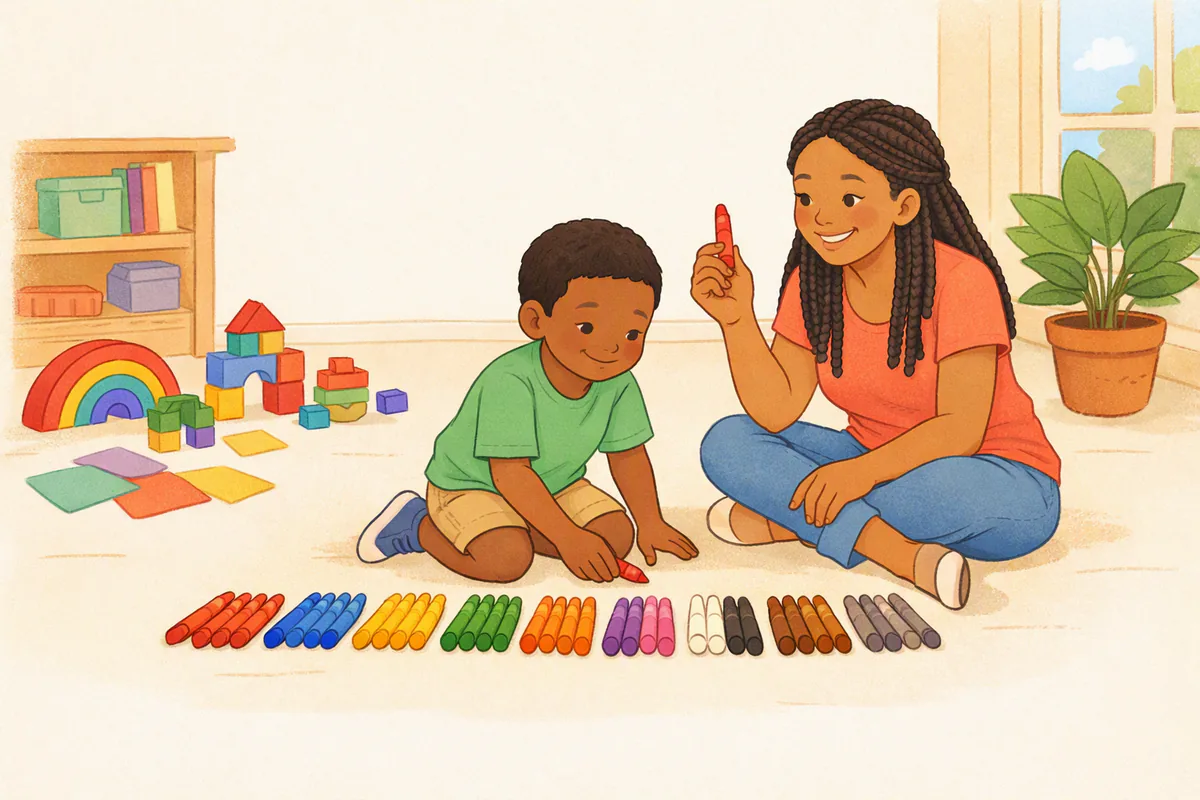
Colors are often the first Spanish words that stick, because a child can point at them all day: the sky, a crayon, a sock. Below are the 11 everyday colors with their English meaning, an easy "say it" guide written for English speakers and Lumi's audio for every word. After the table you will find the two grammar points that matter for kids and two games that take about five minutes.
The colors in Spanish, with audio
| Spanish | English | Say it | Listen |
|---|---|---|---|
| rojo | red | ROH-hoh | |
| azul | blue | ah-SOOL | |
| amarillo | yellow | ah-mah-REE-yoh | |
| verde | green | BEHR-deh | |
| naranja | orange | nah-RAHN-hah | |
| morado | purple | moh-RAH-doh | |
| rosa | pink | ROH-sah | |
| blanco | white | BLAHN-koh | |
| negro | black | NEH-groh | |
| café | brown | kah-FEH | |
| gris | gray | GREES |
Latin American Spanish, as Lumi says it. Brown is café in Mexico; you will also hear marrón. Voices: Lumi (AI-generated voice).
Tap ▶ to hear a word, or "Play all in order" to hear the whole list. The capital letters in the guide show where to put the stress: amarillo is ah-mah-REE-yoh.
How to say the colors
Spanish vowels are short and always sound the same, so once your child knows five sounds, every color is easy to read later on.
- a, e, i, o, u sound like "ah, eh, ee, oh, oo": rosa is ROH-sah, never "ROH-zuh".
- j in rojo and naranja is a breathy h, like a soft laugh: ROH-hoh.
- ll in amarillo sounds like the y in "yes".
- v in verde sounds close to a soft b: BEHR-deh.
- r at the start of a word (rojo, rosa) is rolled. If your child cannot roll it yet, a single tap is fine; it comes with time.
Do colors change in Spanish?
Yes, a little. Many colors end in -o and change to -a when the word they describe is feminine. Colors ending in -e or a consonant only change for plurals.
| One thing | More than one | Example |
|---|---|---|
| rojo / roja | rojos / rojas | la pelota roja ("the red ball") |
| blanco / blanca | blancos / blancas | el gato blanco ("the white cat") |
| verde | verdes | las uvas verdes ("the green grapes") |
| azul | azules | los ojos azules ("the blue eyes") |
Notice the order: the color comes after the thing. Your child does not need the rule; hearing la pelota roja a few times is enough.
Three phrases to practice colors
- ¿De qué color es? (deh KEH koh-LOR ehs): "What color is it?"
- Es verde. (ehs BEHR-deh): "It's green."
- Mi color favorito es el azul. (mee koh-LOR fah-boh-REE-toh ehs ehl ah-SOOL): "My favorite color is blue."
Ask the question about anything in reach: a cup, a car, a cat on a book cover. Accept a one-word answer (verde) with a big smile; full sentences come later.
Two color games for home
- Veo, veo (I spy). Say "Veo, veo algo… rojo" ("I spy something… red") and let your child find it. Then swap roles: your child picks the color and you search. It works in the car, at the store and in a waiting room.
- Color hunt. Say "Busca algo azul" (BOOS-kah AHL-goh ah-SOOL), "Find something blue", and give your child 30 seconds to bring a blue object. Four rounds with four colors is a complete session.
If you do not speak Spanish yourself, play the audio first and repeat after Lumi. Your child hears Lumi's voice too, so don't worry about your accent; our guide to teaching your child Spanish at home explains how to organize practice without being fluent.
In the Lumi Kids app, colors are the second world of the free Seed level. Your child hears rojo, azul and the other colors in a sentence, finds the right picture and then says the words out loud to Lumi, the AI owl. Lumi speaks Latin American Spanish, the same words you see in this table. See the app.
Free colors in Spanish worksheet (PDF)
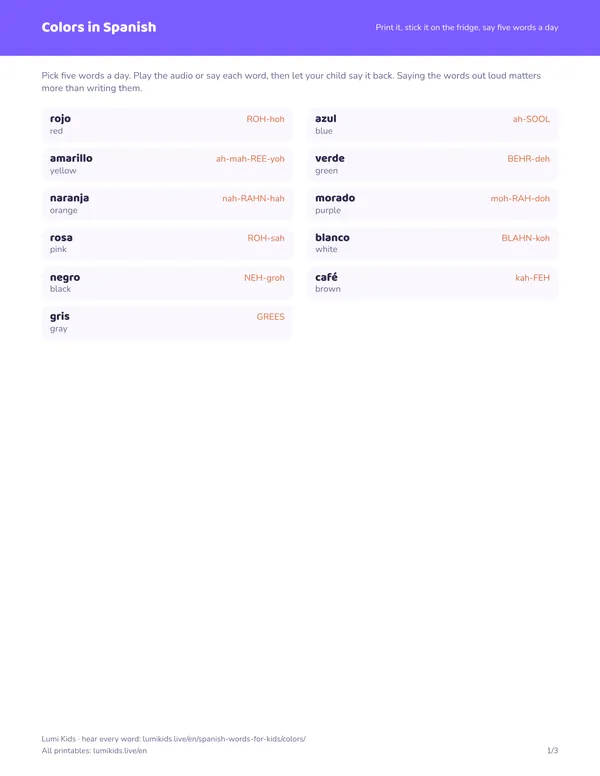
Three pages: the colors with a say-it guide, a matching worksheet (Spanish to English) and a writing sheet. Free to print at home or in class.
Download the PDF: Colors in SpanishMore Spanish words for kids
- Numbers 1–10 in Spanish: count crayons after you sort them by color.
- Animals in Spanish: el gato negro, la vaca blanca.
- Food in Spanish: every fruit has a color.
- All Spanish words for kids and the Spanish for kids page with the 64 first words of the app.
Frequently asked questions
How do you say the colors in Spanish?
Red is rojo (ROH-hoh), blue azul (ah-SOOL), yellow amarillo (ah-mah-REE-yoh), green verde (BEHR-deh), orange naranja (nah-RAHN-hah), purple morado (moh-RAH-doh), pink rosa (ROH-sah), white blanco (BLAHN-koh), black negro (NEH-groh), brown café (kah-FEH) and gray gris (GREES). Tap the words in the table on this page to hear them.
Do colors in Spanish change for boy and girl words?
Colors that end in -o change to -a with a feminine word: el gato blanco, la casa blanca. Colors that end in -e or a consonant stay the same: verde, azul, gris. Most add -s or -es for more than one: verdes, azules.
Is brown café or marrón in Spanish?
Both are correct. In Mexico and much of Central America people usually say café; marrón is common in Spain and in other countries. If your child hears both, that is a bonus, not a problem.
Where does the color go in a Spanish sentence?
After the thing it describes: el perro negro is "the black dog" and los zapatos rojos is "the red shoes". Kids pick this up quickly from short phrases they hear again and again.
How can I teach colors in Spanish to a toddler?
Name colors while you do things you already do: pick a camisa azul (blue shirt) in the morning, sort laundry by color, ask "¿De qué color es?" (What color is it?) about a toy. Short, playful moments every day work better than one long lesson.
Is it naranja or anaranjado?
Both mean orange. Naranja is the word Lumi uses and the one most kids learn first; anaranjado is also common in Latin America, especially in schoolbooks.
In the Lumi Kids app, Lumi the AI owl talks with your child, corrects gently and hands out stars. Ages 4–9, no ads. The first two levels and the first minute of live conversation are free.
Download on the App Store
The team behind Lumi Kids. Articles are written using published research on early-childhood language acquisition and the curriculum built into the app, and are reviewed and updated over time. Questions or corrections: hello@lumikids.live