Lumi Kids
How to Raise a Bilingual Child: Methods That Fit Real Families
To raise a bilingual child, choose a simple language plan your family can keep for years, give your child plenty of time with each language, and create daily moments where your child needs the second language to talk to someone. Two languages don't confuse children or delay speech. Mixing words is a normal stage, and children who answer in English can still become confident bilingual speakers with steady support.
Bilingual families in the US come in many forms. Some parents grew up speaking Spanish, Mandarin, Arabic or Tagalog and want to pass it on. Some families have one parent with a second language. And many English-speaking families want their child to grow up with a language nobody at home speaks. In 2019, 67.8 million people in the US spoke a language other than English at home; Spanish was 62% of them, followed by Chinese, Vietnamese, Tagalog and Arabic (US Census Bureau, December 2022). This guide gives each type of family a realistic plan.
What does "bilingual" mean for a child?
For a 4- to 9-year-old, bilingual rarely means "equally strong in both." Most bilingual children have a stronger language that changes over time, usually the language of school and friends. That is normal.
It helps to separate two skills:
- Understanding. Many children understand a second language well, for example from a grandparent, but rarely speak it.
- Speaking. Speaking needs practice with someone who expects an answer in that language.
Often, when a family says "it isn't working", the child understands but doesn't speak. The fix is more chances to speak, not more listening.
Which family language plan should you choose?
Pick the plan that matches who speaks what in your home. Consistency matters more than the label.
| Plan | How it works | Suits | Watch out for |
|---|---|---|---|
| One parent, one language (OPOL) | Each parent speaks their own language to the child | Families where one parent speaks the second language | The child may hear it less than English; add other sources |
| Home language at home | Everyone speaks the second language at home; English comes from school and outside | Families where both parents speak it | Older siblings bring English home; keep home time protected |
| Time and place | The second language at set times or places: breakfast, weekends, Grandma's house | Mixed families, busy schedules | Needs a fixed routine to work |
| Learning family (no native speaker) | Daily language time, an immersion school, a caregiver or class, media and apps | English-only families | Needs outside speakers; set realistic expectations |
You can combine plans. A family might use OPOL during the week and the home language for all of Sunday. What matters is that your child can predict when the second language will be used, and that there are enough hours of it.
Will two languages delay my child's speech?
No. ASHA says on its family site that using multiple languages does not confuse children or cause speech or language delays, that children typically say first words around age 1 and two-word phrases around age 2, and that blending words or grammar rules from different languages is an expected part of learning more than one language (ASHA / CHSA).
Two practical points:
- Count words in both languages. A bilingual 3-year-old may know some words only in Spanish and others only in English. Together, they add up.
- Real difficulties show up in both languages. ASHA notes that a communication issue shows up in all the languages a child uses. If you are worried, see a speech-language pathologist, ideally one who works with bilingual children, instead of dropping a language.
My child understands but answers in English. What now?
This is a very common moment of doubt, and it often starts when a child begins school. Children use the language that works. If everyone understands English, English wins. Your job is to make the second language useful again.
- Keep speaking it yourself, even when your child answers in English. Your input keeps their understanding alive.
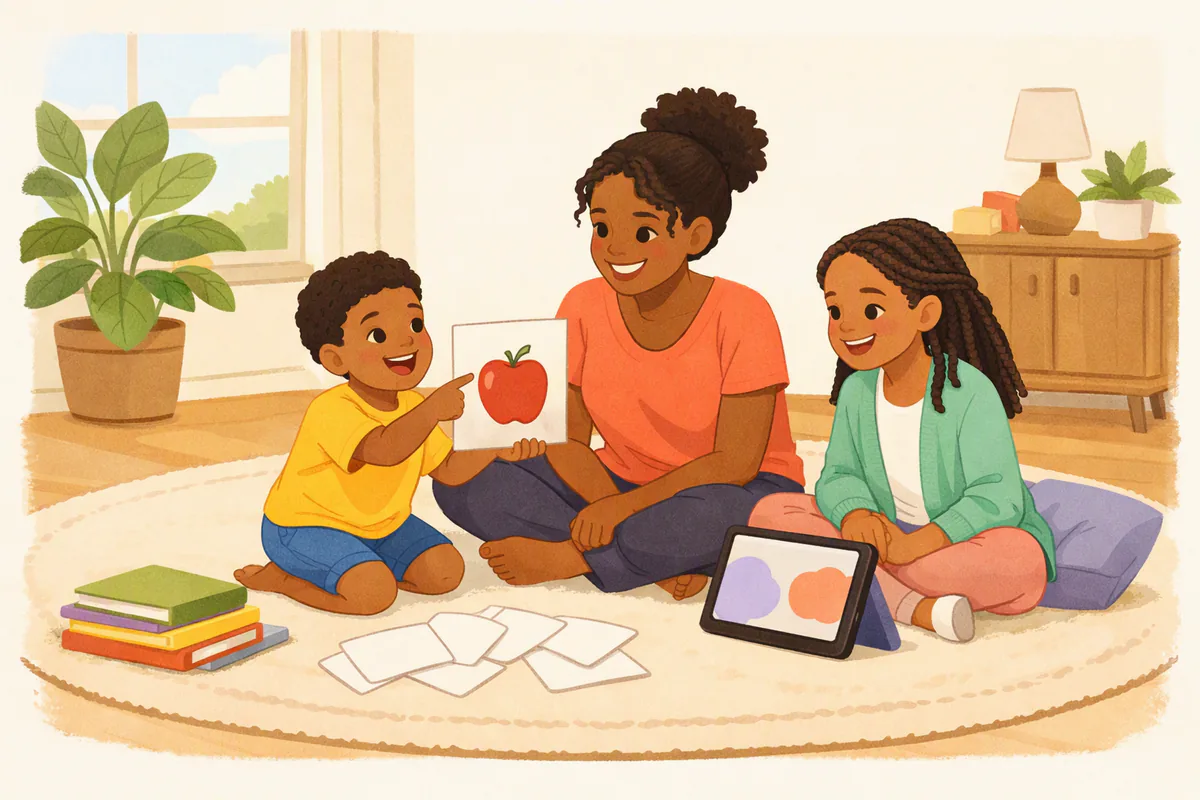
- Ask questions that need a short answer in the language. "¿Quieres manzana o plátano?" (Apple or banana?) is easy to answer in Spanish.
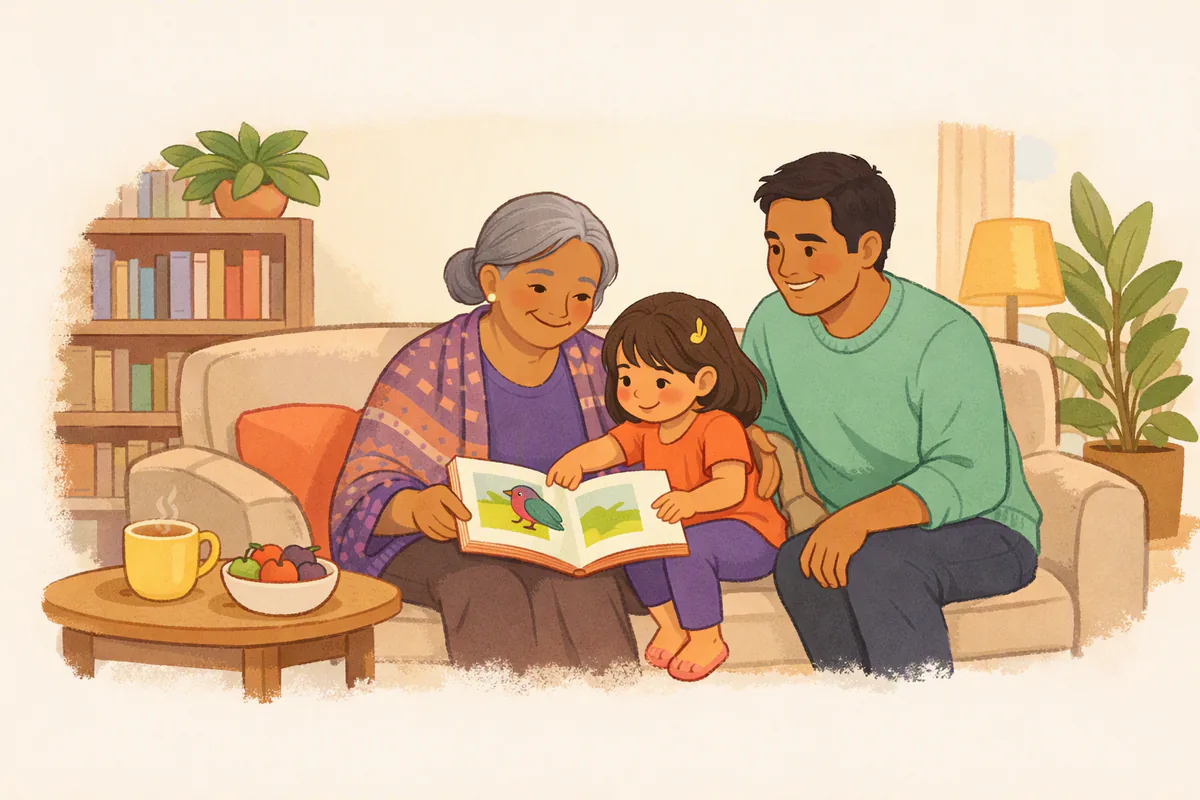
- Create situations where English doesn't help: a weekly video call with a grandparent who speaks only the home language, a babysitter, a playgroup.
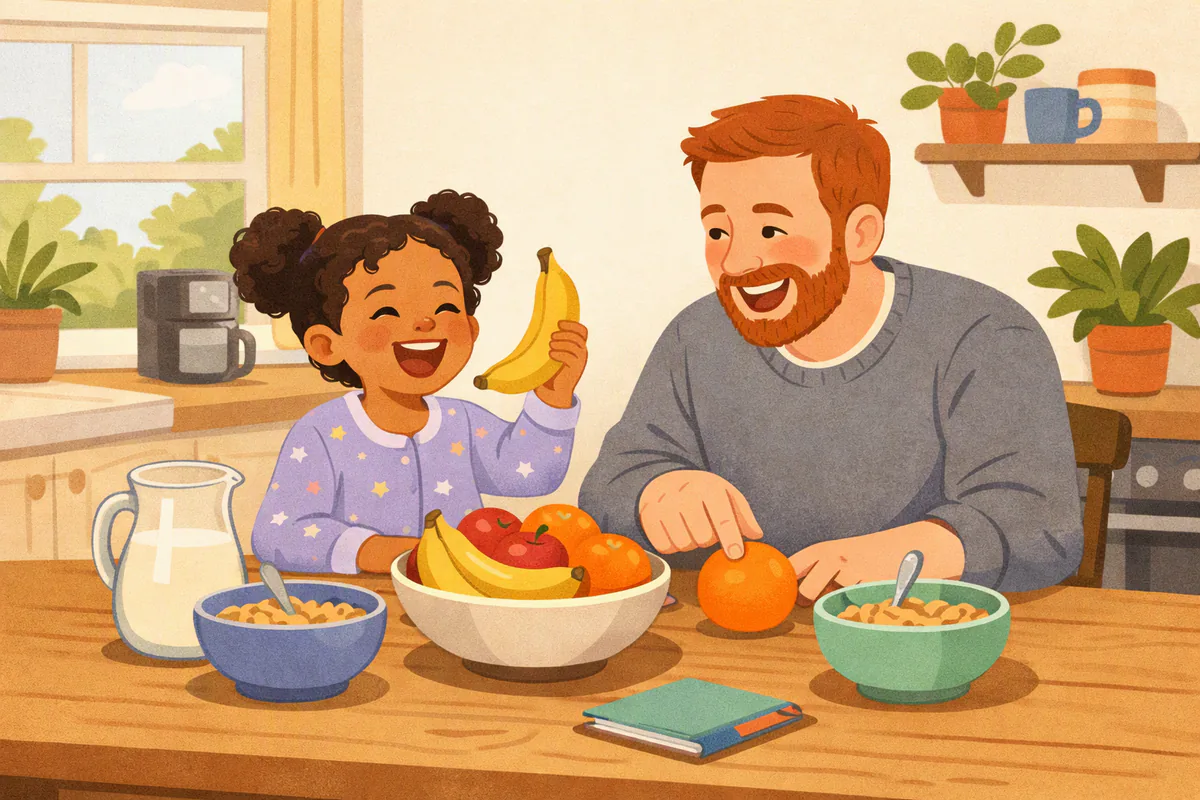
- Use rituals. Bedtime stories, a song in the car, a weekend breakfast "in Spanish only."
- Never shame. "Why don't you speak properly?" makes children speak less. "I love hearing you say that in Spanish!" makes them speak more.
- Travel and visits help a lot when they are possible, because the language suddenly becomes necessary.
How do you keep a heritage language alive?
A heritage language is more than vocabulary. It connects your child to grandparents, stories, food and faith. Three things help keep it going:
| What | How |
|---|---|
| Regular contact with family | A fixed weekly call, letters or voice messages to grandparents |
| Community | Weekend heritage schools, cultural centers, places of worship, playgroups |
| Stories and media | Books from the library, songs, shows and films in the language |
If your child's school offers a two-way immersion or heritage language program, it can be a strong support; our guide to dual language immersion explains the program types and what to ask.
Can a family that only speaks English raise a bilingual child?
Yes, but it takes more planning, because the language has to come from outside the family. Realistic sources, from the most hours to the fewest:
- An immersion or dual language school, or a caregiver who speaks the language.
- A class, a tutor or a weekend school.
- Relatives or friends who speak it, on a fixed schedule.
- Daily home routines with songs, books, shows and a speaking app.
Expect your child to understand more than they say for a long time, and celebrate small steps. Our guide on how to teach your child Spanish at home, even if you don't speak it gives a full daily plan, and our article on the best age to learn a second language explains what is realistic at each age.
Speaking practice between visits. Lumi Kids is an iPhone and iPad app for ages 4–9 in which Lumi, an AI owl, explains in English (or in one of 15 other home languages) while your child practices speaking Spanish, French, Mandarin, Arabic, Italian, Portuguese, Turkish, Japanese, Korean or German. The first two levels and 60 seconds of live talk are free; Lumi Plus ($14.99 a month or $119.99 a year on the US App Store, checked October 5, 2026) unlocks the last two levels and 10 minutes of live talk a week. There are up to four child profiles, so siblings each keep their own progress. See the app.
When should a bilingual child learn to read and write in both languages?
Speaking comes first. From about 6, when your child is learning to read in English at school, reading in the second language helps it last, because books bring words your family doesn't use every day.
- Languages with the Latin alphabet (Spanish, Italian, Portuguese, French, German): your child can often start reading simple words soon after reading in English. Spanish, Italian and Portuguese are spelled quite regularly, which helps.
- Languages with another script (Arabic, Mandarin, Japanese, Korean): reading needs dedicated time, often at a weekend school or with a tutor. Start with a few characters or letters that matter to your child, such as their name.
- Writing can be playful: a shopping list, a birthday card for Grandma, labels on drawings.
A simple weekly plan for a bilingual family
| Day | Activity (10–20 minutes) |
|---|---|
| Monday | Bedtime story in the second language |
| Tuesday | Cooking or snack time with food words |
| Wednesday | Video call with a relative or a playdate with a speaker |
| Thursday | A song and a short show, then two questions about it |
| Friday | Game night: a board or card game played in the language |
| Saturday | Outing with the language: library, community event, market |
| Sunday | Breakfast in the language only, and plan the week together |
Adjust the plan to your family. The goal is that the second language shows up every day in a moment your child enjoys.
The bottom line
Raising a bilingual child is less about the perfect method and more about steady, warm, everyday use. Choose a plan your family can keep, give your child reasons to speak, ignore the myth that two languages cause delays, and celebrate every word. The years from 4 to 9 are a wonderful time to build a second language that lasts.
Frequently asked questions
Do bilingual children talk later?
Learning two languages does not cause speech or language delays, according to ASHA, the American Speech-Language-Hearing Association. Bilingual children reach first words and first word combinations on the usual timeline, although their vocabulary is spread across two languages. If your child seems behind, talk to a speech-language pathologist; a real difficulty shows up in all of a child's languages.
Is mixing two languages a problem?
No. Blending words or grammar from both languages is an expected part of learning more than one language. Children use every word they have to get their message across. Answer naturally, repeating the idea in the language you are using, and the mixing fades as both languages grow.
What if only one parent speaks the second language?
That is the classic situation for the one-parent-one-language approach: the parent who speaks the second language uses it with the child as much as possible, and the other parent supports it with interest, books and visits. Because the child hears that language less, add other sources too: relatives, playgroups, classes, songs and shows.
My child understands our home language but answers in English. What now?
This is very common, especially once school starts. Keep speaking the home language, ask questions that need a short answer in it ("¿Leche o agua?"), create situations where English doesn't help, such as calls with a grandparent who doesn't speak English, and praise every attempt. Avoid shaming or refusing to listen; that tends to make children speak even less.
Can we raise a bilingual child if neither parent is a native speaker?
Yes, but you will rely more on other speakers: an immersion school, a caregiver, a class or tutor, relatives and friends, plus books, songs and apps. Your own learning alongside your child helps too. Expect it to take longer than in a home where the language is spoken all day.
Should we drop the home language if the school is worried about English?
Usually no. ASHA notes that using multiple languages does not cause delays and that a strong first language supports learning another one. If the school has concerns, ask for an assessment by a speech-language pathologist who knows bilingual children, rather than dropping the language that connects your child to family.

In the Lumi Kids app, Lumi the AI owl talks with your child, corrects gently and hands out stars. Ages 4–9, no ads. The first two levels and the first minute of live conversation are free.
Download on the App Store
The team behind Lumi Kids. Articles are written using published research on early-childhood language acquisition and the curriculum built into the app, and are reviewed and updated over time. Questions or corrections: hello@lumikids.live