Lumi Kids
Teach Your Child Spanish at Home (Even If You Don't Speak It)
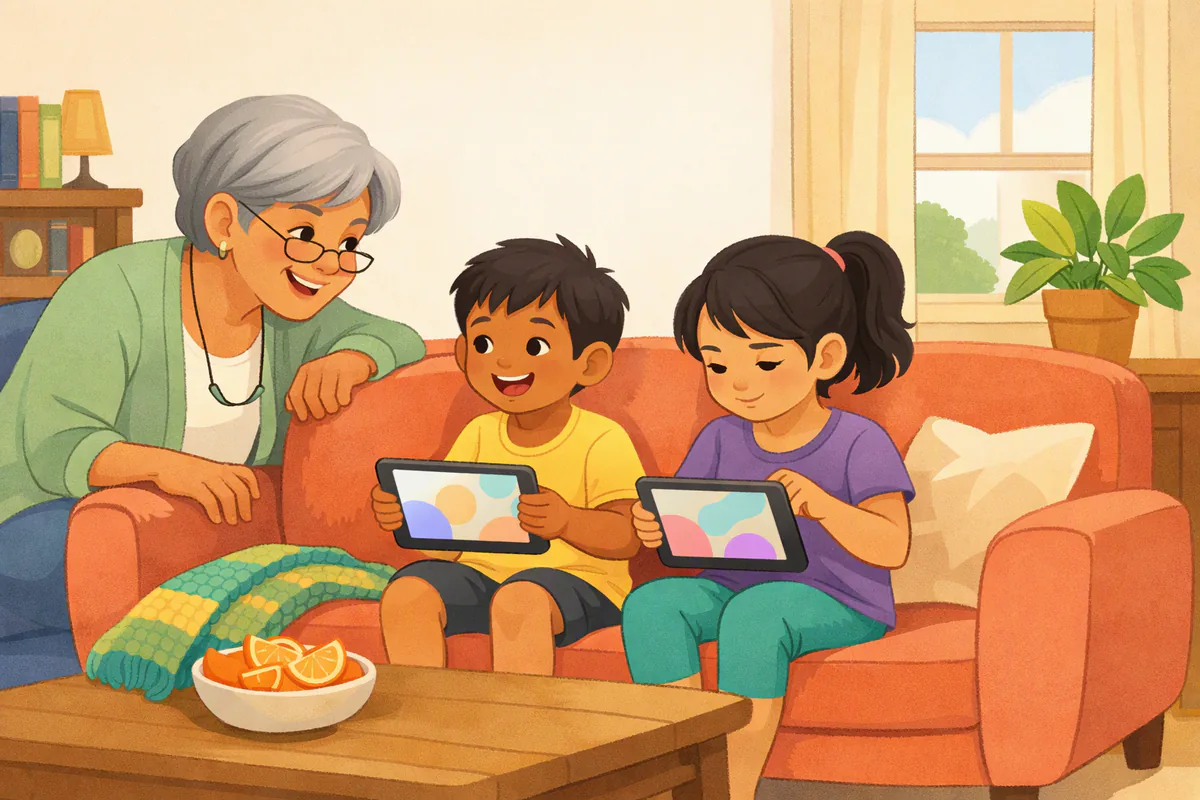
You can teach your child Spanish at home even if you don't speak it. Your role is to organize daily contact with the language: short routines, songs, stories, games and a regular source of real Spanish speech, such as a relative, a class or a speaking app. Ten to fifteen minutes a day, spread across small moments, is easier to keep up than one long weekly session.
Many parents searching for this are in the same spot: they want their child to have the Spanish they never learned, nobody at home speaks it, and the school offers little or none. In the US that is the norm, not the exception. Only 20% of public elementary schools offered any world-language class in January 2024, according to federal survey data (ACTFL report on NCES data, March 2026). This guide gives you a plan you can start tomorrow.
Can you really teach Spanish without speaking it?
Yes, if you split the job in two. You provide the routine and the motivation; someone or something else provides the Spanish your child copies. That second part can be a song, an audiobook, a show, a grandparent on a video call, a teacher or an app with native-speaker audio.
| You do this | The Spanish source does this |
|---|---|
| Pick the time of day and keep it going | Gives correct pronunciation |
| Choose words that matter to your child | Repeats them in real sentences |
| Turn practice into games | Asks your child to answer |
| Learn along with your child and praise effort | Corrects gently and models the next step |
Learning alongside your child is not a weakness. Kids love it when they know a word you don't, and asking "Can you teach me how to say dog?" turns your child into the expert. ASHA's family site lists reading books, singing songs, watching programs in the language and enrolling in language programs among the ways to support a child learning more than one language (ASHA / CHSA), and none of them requires you to be fluent.
What does a daily Spanish routine look like?
Think "little and often." Here is a 15-minute day that fits around school, dinner and bedtime. Adjust the length to your child's age.
| Moment | Ages 4–5 | Ages 6–7 | Ages 8–9 |
|---|---|---|---|
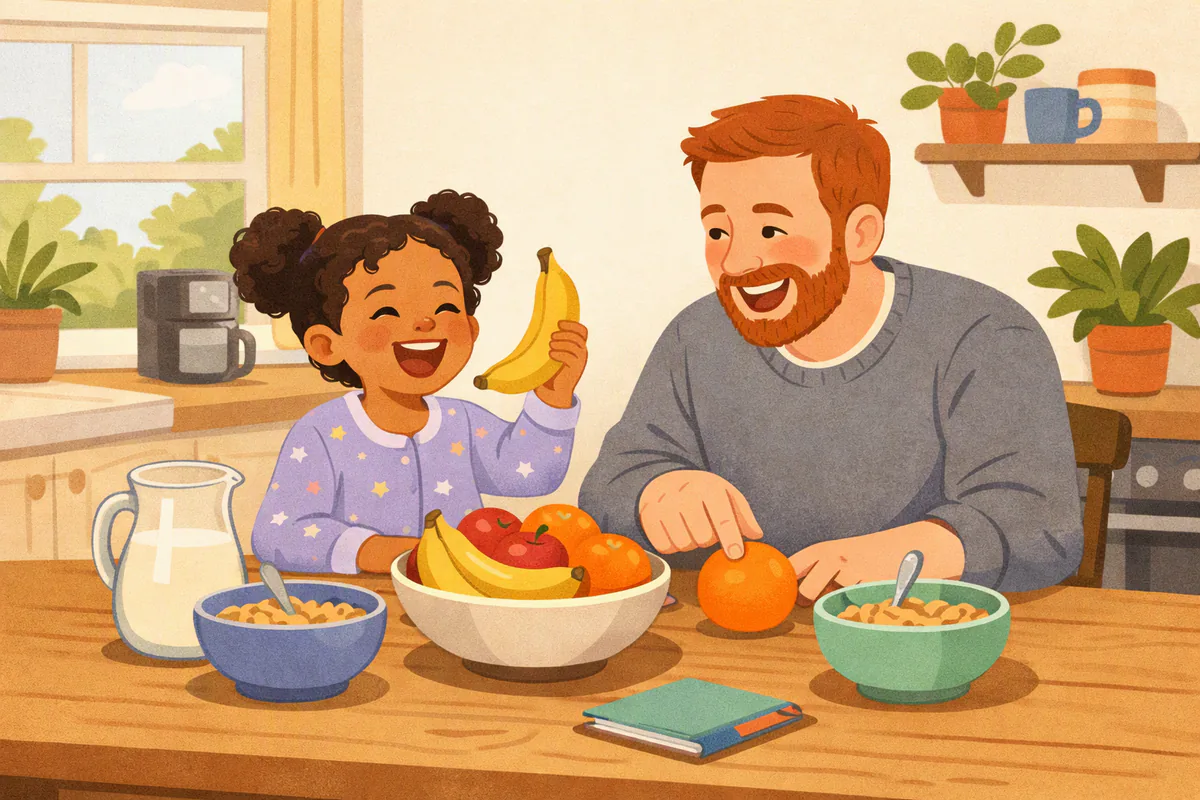
| Breakfast (2–3 min) | One Spanish song, the same all week | Song + say the day: hoy es lunes | Say the day and the weather |
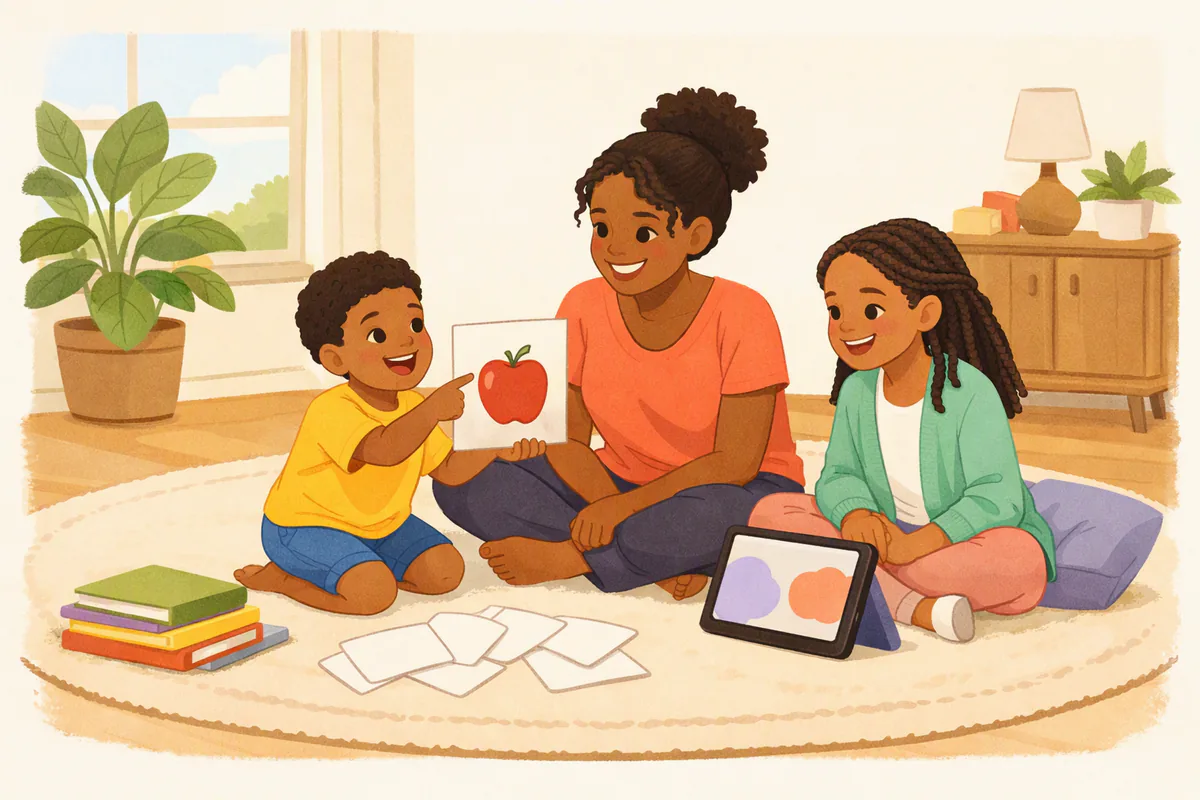
| After school (5 min) | Color or animal game | Picture-card game, 5 new words | A short lesson or app session with speaking |
| Dinner (2 min) | Name 3 foods on the table | "¿Qué quieres?" (What do you want?) with 2 choices | Your child teaches you one word from today |
| Bedtime (5 min) | Bilingual picture book | Same book, child names the pictures | Child reads a simple page or retells a story |
Two rules make the routine last. Keep each piece short enough that your child wants more, and keep the time of day fixed so Spanish becomes part of the day instead of an extra task.
Which Spanish words should you start with?
Start with words your child already uses many times a day in English. Our Spanish words for kids pages have each word with Lumi's audio, so you can hear it before you say it. Here is a first set with simple say-it guides (capital letters show the stressed syllable).
| Spanish | English | Say it |
|---|---|---|
| hola | hello | OH-lah |
| gracias | thank you | GRAH-see-ahs |
| por favor | please | por fah-BOR |
| buenos días | good morning | BWEH-nohs DEE-ahs |
| rojo | red | ROH-hoh |
| azul | blue | ah-SOOL |
| amarillo | yellow | ah-mah-REE-yoh |
| verde | green | BEHR-deh |
Add numbers by counting stairs, snacks or toys, and animals with picture books. Our Spanish for kids page lists the 64 first words a child learns in the app, grouped by topic, each with Lumi's audio. When you're ready for more, try colors in Spanish, numbers 1–10 and greetings, and print a matching worksheet from our free printables.
How do you use songs, shows and books without just adding screen time?
Media works best when it is repeated and when it leads to talking. A few practical rules:
- One song, one week. Play the same short song every day until your child sings along. Singing is speaking, so it counts as real practice.
- Familiar stories first. A show or book your child already knows in English is easier in Spanish, because they can follow the story and focus on the words.
- Watch, then talk. After a short episode, ask two questions with Spanish words in them: "¿De qué color es el perro?" (What color is the dog?) Point if needed.
- Library over shopping. Many public libraries have bilingual picture books and Spanish audiobooks, so you can rotate books every few weeks for free.
For young children, keep screens in proportion. The World Health Organization advises no more than one hour of sedentary screen time a day for children aged 3–4, and says less is better (WHO, April 2019).
How do you get your child to speak, not just listen?
Most children understand Spanish long before they say it. That gap is normal, but it closes only when your child has reasons to answer. Try these:
- Offer two choices. "¿Leche o agua?" (Milk or water?) A one-word answer in Spanish is an easy win.
- Let a toy speak only Spanish. A stuffed animal who "doesn't understand English" makes speaking Spanish a game, not a test.
- Play "teach me." At dinner, your child teaches you one word from their day. Get it wrong on purpose sometimes; they will love correcting you.
- Use Spanish for routines. Vamos (let's go), zapatos (shoes), a comer (time to eat): the same phrases at the same moments every day.
- Celebrate attempts. "You said that in Spanish!" matters more than whether the ending was right.
A sample exchange with a 5-year-old might sound like this:
You: ¿De qué color es tu camiseta? (What color is your T-shirt?)
Child: Blue!
You: Sí, azul. ¿Azul?
Child: Azul!
You: ¡Muy bien!
That is a full lesson. Thirty seconds, one word said out loud, and a child who feels successful.
Where does real speaking practice come from?
At some point your child needs someone who answers back in Spanish. Here are the realistic options for a family that doesn't speak it:
| Source | What it gives | Things to check |
|---|---|---|
| A relative or friend who speaks Spanish | Real conversation, family connection | A fixed weekly time (even 10 minutes by video) |
| A babysitter or daycare that uses Spanish | Hours of natural exposure | Ask how much of the day is really in Spanish |
| A class or tutor | Structure, correction, a teacher's ear | How many minutes your child actually speaks per session |
| An immersion or dual language school | Daily exposure across subjects | See our guide to dual language immersion |
| An app that asks for spoken answers | Daily practice on days nothing else happens | Whether your child speaks or only taps |
Lumi Kids for the speaking part. Lumi Kids is an iPhone and iPad app for ages 4–9 in which Lumi, an AI owl, explains in English and asks your child to say Spanish words and answer out loud. The first two levels and 60 seconds of live talk with Lumi are free; Lumi Plus ($14.99 a month or $119.99 a year on the US App Store, checked October 5, 2026) unlocks the last two levels and 10 minutes of live talk a week. There is no account and no ads, and the app doesn't record or store your child's voice. Learn more about the app.
If you are weighing apps, our comparison of the best Spanish apps for kids lists what each one asks a child to do, with dated prices.
What mistakes make kids give up on Spanish?
Practice that starts to feel like school is hard to keep going. Watch for these:
| Instead of this | Try this |
|---|---|
| Quizzing: "What's red in Spanish? And blue? And green?" | A game: "Find something rojo in the room!" |
| Correcting every word | Repeat the right form once, naturally, and move on |
| Long sessions on weekends only | A few minutes every day |
| Asking your child to perform for relatives | Let them choose when to show off |
| Changing apps or books every week | Repeat the same material until it feels easy |
What does progress look like?
Progress at this age is quiet, and every child moves at a different pace. Instead of fluency, look for small, concrete signs. They tend to appear in roughly this order:
- Recognition. Your child reacts to the routine words, sings part of a song and answers choice questions with one word.
- Understanding. Your child follows simple instructions in Spanish, uses a few words without being asked and notices Spanish they hear outside the home.
- First phrases. Your child puts two or three words together (más agua, por favor), asks how to say new things and may start correcting your pronunciation.
If you see stage 1 after a few weeks of daily practice, the routine is working; keep it going rather than adding more.
If your child is older, you can add reading and writing: Spanish is spelled very regularly, so simple words are easy to decode once your child reads in English. Our article on the best age to learn a second language explains what is realistic at each age, and Spanish for kids beyond the classroom shows how to support a school Spanish class at home.
The bottom line
You don't need to speak Spanish to raise a child who does. Set a short daily routine, start with the words your child uses most, add one reliable source of real Spanish, and give your child reasons to answer. Keep it light, keep it going, and learn alongside them.
Frequently asked questions
Can I teach my child Spanish if I don't speak it?
Yes, as long as you see your role as organizer rather than teacher. You choose the routine, the songs, books and shows, and you find a source of real Spanish speech: a relative, a class, a babysitter or a speaking app. Learning alongside your child also works well, because children enjoy catching their parents out and teaching them a word.
How do I teach my toddler Spanish?
With a toddler, think exposure, not lessons. Use the same few songs every day, name things during routines (shoes, water, bath, dog), read short picture books with Spanish words, and repeat them for weeks. Don't ask a toddler to perform words on request; they will understand long before they speak.
What Spanish words should my child learn first?
Start with the words your child uses most in English: greetings and polite words (hola, adiós, gracias, por favor), colors, numbers 1–10, family words (mamá, papá, abuela), favorite foods and animals. A set of 30–60 everyday words is a good first goal, and you can practice them in games instead of lists.
How long does it take a child to learn Spanish?
There is no honest single number, because it depends on how many hours a week your child hears and uses Spanish. Understanding everyday words comes first and using short phrases comes later. Becoming conversational takes years of steady contact, which is why consistency matters more than intensity.
Is it OK if my pronunciation isn't perfect?
Yes. Make sure your child also hears native speakers through songs, audiobooks, shows, classes or an app, and they will pick up the sounds from those. Your imperfect Spanish shows them that trying is normal, which is worth more than a perfect accent.
Should I correct my child's Spanish mistakes?
Rarely and gently. Instead of saying "no, that's wrong," repeat the sentence back correctly in a natural way: if your child says "el casa," answer "Sí, la casa grande." Constant correction can make a child stop trying.
Are Spanish cartoons enough to learn Spanish?
Cartoons help your child's ear and make Spanish feel normal, but watching is passive. Children learn to speak by speaking, so pair shows with moments where your child has to answer: ask about the episode with simple Spanish words, sing the theme song together, or play a game with the characters' names.
What free resources can I use to teach Spanish at home?
Your public library is the best free resource: bilingual picture books, Spanish audiobooks and sometimes free access to language programs. Add free songs and videos, our free Spanish printables, and the Spanish words pages with audio. Many apps also have free first levels you can use for speaking practice.
In the Lumi Kids app, Lumi the AI owl talks with your child, corrects gently and hands out stars. Ages 4–9, no ads. The first two levels and the first minute of live conversation are free.
Download on the App Store
The team behind Lumi Kids. Articles are written using published research on early-childhood language acquisition and the curriculum built into the app, and are reviewed and updated over time. Questions or corrections: hello@lumikids.live