Lumi Kids
Toys and Home Words in Spanish for Kids (With Audio)
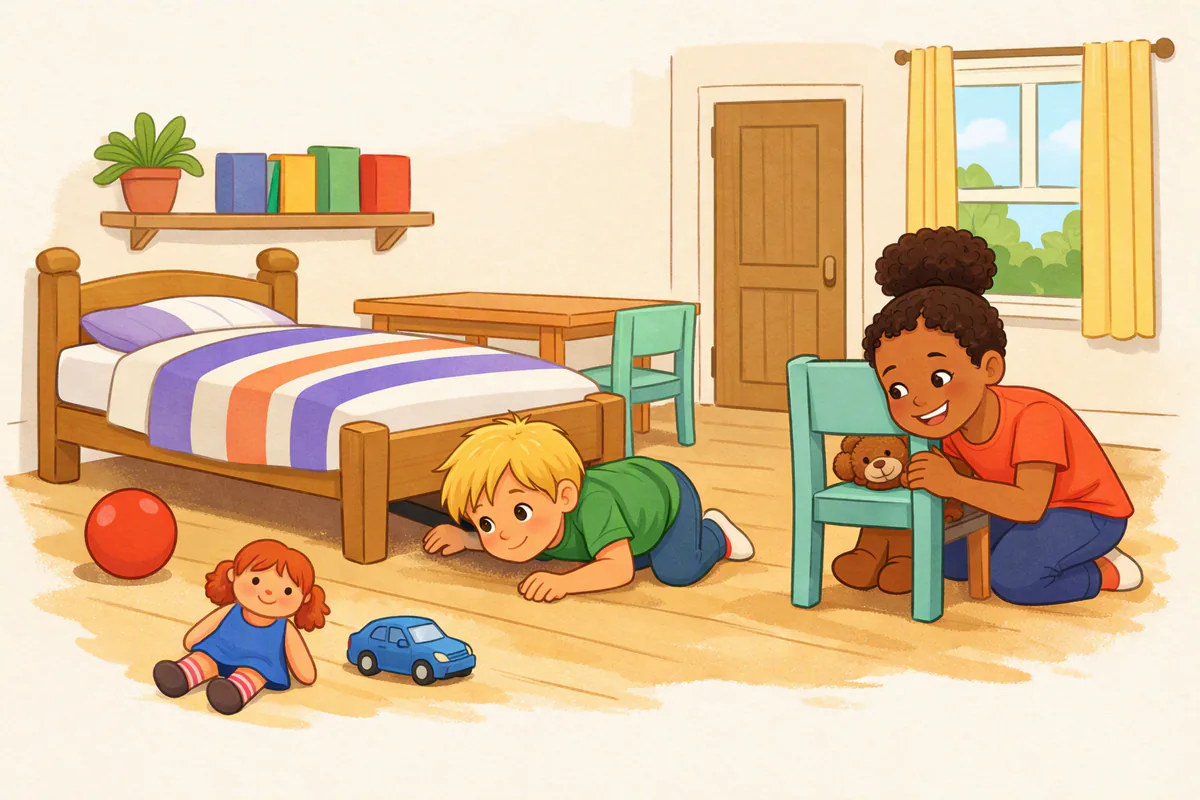
Toys and the things in a child's room are words your child touches every day, and they make the best game in this collection: hide something and ask where it is. Here are 12 toy and home words in Spanish with English meanings, an easy "say it" guide and Lumi's audio, plus the three little words that turn them into sentences.
Toys and home words in Spanish, with audio
| Spanish | English | Say it | Listen |
|---|---|---|---|
| pelota | ball | peh-LOH-tah | |
| carro | car | KAH-rroh | |
| muñeca | doll | moo-NYEH-kah | |
| libro | book | LEE-broh | |
| osito de peluche | teddy bear | oh-SEE-toh deh peh-LOO-cheh | |
| juguete | toy | hoo-GEH-teh | |
| cama | bed | KAH-mah | |
| silla | chair | SEE-yah | |
| mesa | table | MEH-sah | |
| puerta | door | PWEHR-tah | |
| ventana | window | behn-TAH-nah | |
| casa | house | KAH-sah |
Carro is the Latin American word for car; Spain says coche. Voices: Lumi (AI-generated voice).
Sounds to notice: ñ in muñeca is like the ny in "canyon" (moo-NYEH-kah), rr in carro is rolled, ll in silla sounds like y, and g before e in juguete is a hard g because of the silent u (hoo-GEH-teh).
Under, on top of, behind
Three place words let your child describe where anything is:
| Spanish | Say it | English | Example |
|---|---|---|---|
| debajo de | deh-BAH-hoh deh | under | debajo de la cama |
| encima de | ehn-SEE-mah deh | on top of | encima de la mesa |
| detrás de | deh-TRAHS deh | behind | detrás de la puerta |
De plus el becomes del: debajo del libro, "under the book".
The hide-and-find game
It needs nothing but a toy.
- Your child closes their eyes (cierra los ojos) while you hide a toy.
- Ask ¿Dónde está el osito? (DOHN-deh ehs-TAH ehl oh-SEE-toh), "Where is the teddy bear?"
- While your child searches, say frío (FREE-oh, "cold") when they are far away and caliente (kah-LYEHN-teh, "hot") when they get close.
- When they find it, they say where it was: ¡Está debajo de la silla! Then it is your turn to search.
Four rounds take about five minutes. With a 4-year-old, hide the toy in plain sight and use just one place word; 7- to 9-year-olds can take turns hiding and giving the clues in Spanish.
For more games like this and a simple weekly plan, see our guide to teaching your child Spanish at home.
In the Lumi Kids app, toys and home are the eighth world of the free Seed level, "Toys & Home": pelota, carro, muñeca, libro, osito de peluche, cama, silla and casa. Your child hears them in sentences like Juego con mi muñeca ("I play with my doll") and then talks about them with Lumi, the AI owl. See the app.
Free toys and home words worksheet (PDF)
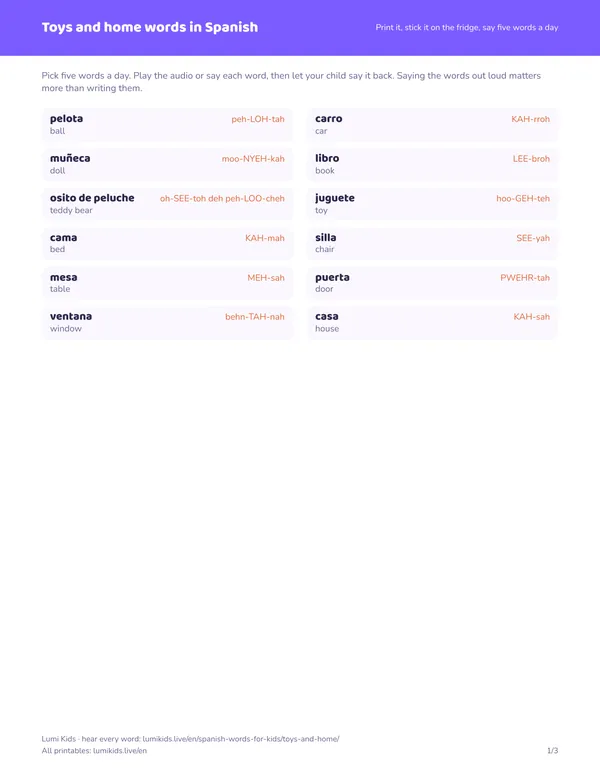
Three pages: the toy and home words with a say-it guide, a matching worksheet (Spanish to English) and a writing sheet. Free to print at home or in class.
Download the PDF: Toys and home words in SpanishMore Spanish words for kids
- Animals in Spanish: toy animals are perfect for hide-and-find.
- Colors in Spanish: la pelota roja, el carro azul.
- Family words in Spanish: who hid the teddy bear?
- All Spanish words for kids.
Frequently asked questions
How do you say toys in Spanish?
A toy is a juguete (hoo-GEH-teh), toys are juguetes. Ball is pelota (peh-LOH-tah), car carro (KAH-rroh), doll muñeca (moo-NYEH-kah), book libro (LEE-broh) and teddy bear osito de peluche (oh-SEE-toh deh peh-LOO-cheh).
Is car carro or coche in Spanish?
Carro is the usual word in Mexico, Central America and much of South America; Spain says coche, and Argentina often auto. Lumi uses carro.
How do you say where is it in Spanish?
¿Dónde está…? (DOHN-deh ehs-TAH): ¿Dónde está el libro? is "Where is the book?" The answer starts with Está…: Está debajo de la cama, "It's under the bed".
What does osito de peluche mean word for word?
"Little bear of plush": oso is bear, -ito makes it small and cute, and peluche is the soft fabric of stuffed toys. Many kids simply say mi osito.
How do you say my room in Spanish?
Mi cuarto or mi habitación; in Mexico you will also hear mi recámara. Any of them works.
In the Lumi Kids app, Lumi the AI owl talks with your child, corrects gently and hands out stars. Ages 4–9, no ads. The first two levels and the first minute of live conversation are free.
Download on the App Store
The team behind Lumi Kids. Articles are written using published research on early-childhood language acquisition and the curriculum built into the app, and are reviewed and updated over time. Questions or corrections: hello@lumikids.live